5 businesses in Africa with potential to attract investment and grants
By Afrobees Group
If you’re planning to build a business in Africa, especially from the diaspora, it helps to ask early: Who might fund this business, and what would they need to see first?
The answer depends on what you’re building. An equity investor buys a stake and looks for a credible path to growth and a return. A grant funder backs a defined project or outcome, such as reducing food loss or expanding access to electricity. A lender looks for evidence that the business can repay. The same company could use a grant to test a new service, a loan to buy equipment, and equity to expand into new markets.
The funding data gives founders a starting point. Partech tracked US$2.4 billion in equity investment across 462 African tech deals in 2025. Fintech led with US$769 million, followed among the sectors discussed here by cleantech at US$550 million and healthtech at US$215 million. These figures describe tracked tech deals. The funding prospects for a new poultry farm, delivery company, or food processor depend on its own customers, economics, and eligibility. partechpartners.com
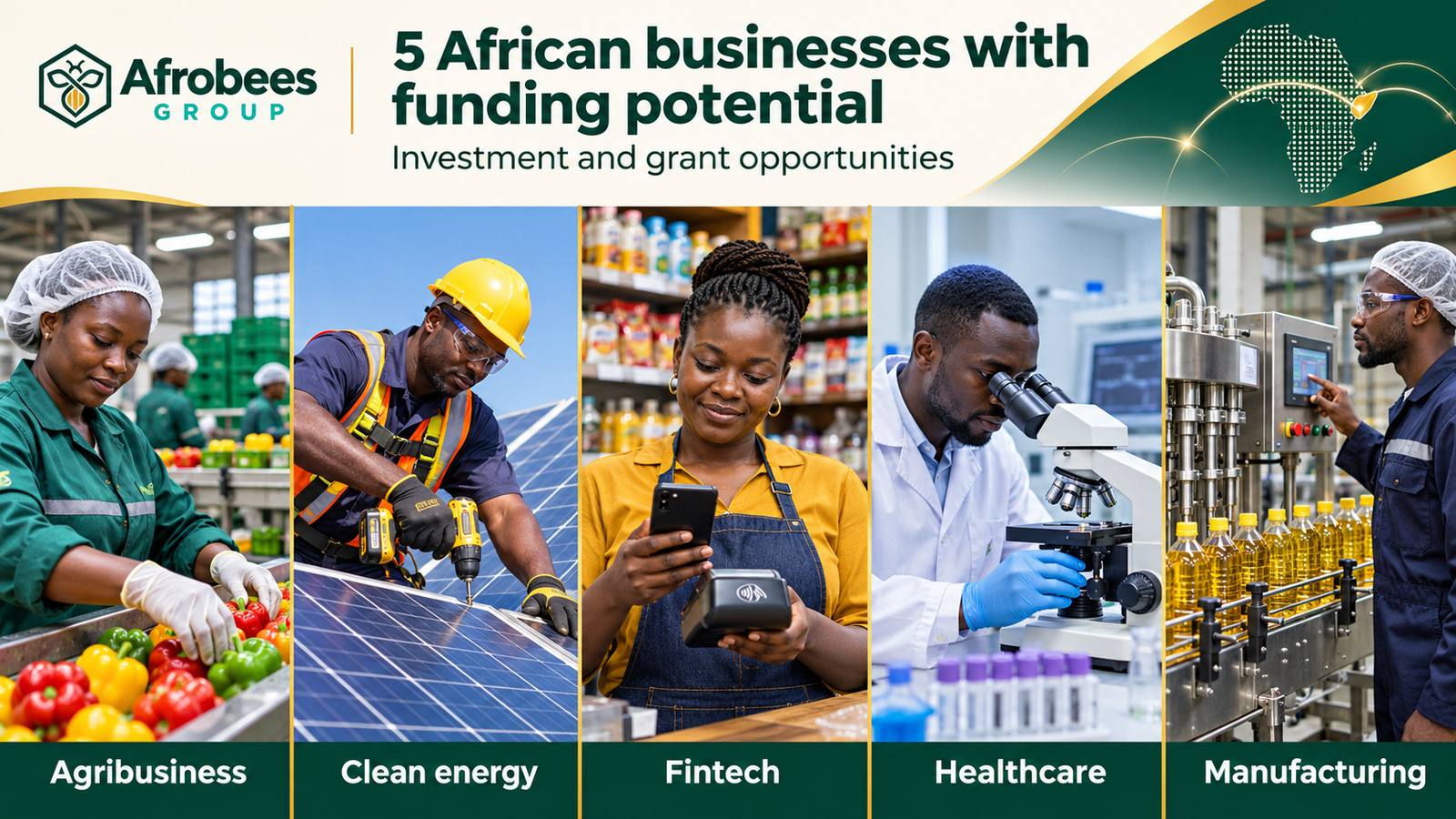
Here are five business models worth exploring and what founders can do to become credible funding candidates.
1. Agribusiness and food processing
A business could run a seafood cold chain, process and package local produce, or build an egg distribution network that buys from small poultry farms and supplies shops and bakeries.
Where funding may fit. Agribusiness challenge funds can support pilots with measurable benefits for producers, such as reducing spoilage or increasing the volume farmers can sell. A processor with repeat wholesale orders may have a case for equipment finance or a strategic investor. The Africa Enterprise Challenge Fund (AECF) runs agribusiness competitions and describes using grants to test models, fund feasibility work, and run pilots. AECF
What to prove first. Secure a buyer, run paid orders, and show your margin after transport, power, and spoilage. For a grant proposal, measure the improvement you want to fund. If you plan to reduce spoilage, document current losses and how you’ll track them during the pilot.
2. Clean energy for small businesses
A startup could help clinics, farms, shops, or food processors switch to solar and battery systems. It can begin with energy assessments, installations through a qualified partner, and maintenance contracts.
Where funding may fit. Energy-access programmes can support projects that serve underserved communities. Equipment finance can help purchase assets when customer contracts support repayment. Equity becomes more relevant if the company can repeat its sales, installation, and maintenance model across many sites. In Somalia, for example, AECF’s REACT 2.0 programme supports private-sector delivery of decentralized renewable energy to underserved communities. AECF
What to prove first. Gather customers’ electricity and generator bills. Use early installations to show actual savings, system uptime, and how reliably customers pay.
3. Fintech and tools for small merchants
A founder could help wholesalers reconcile mobile-money payments, match transfers to invoices, or track what customers owe across several branches. A paid tool for one type of merchant is a manageable starting point.
Where funding may fit. Equity is the clearer path if the product earns recurring revenue and can reach many merchants. A financial inclusion grant or challenge fund may fit a project that demonstrably improves access for underserved businesses. AECF, for example, includes rural financial services among its competition themes. partechpartners.com
What to prove first. Get merchants to pay for the product and show that they keep using it. Measure the hours it saves or the payment errors it helps resolve. Establish what approvals or licensed partnerships you need before handling payments or offering credit.
4. Healthcare access and diagnostics
A business could collect and transport diagnostic samples from smaller clinics to licensed laboratories. Another option is a tool that helps clinics track referrals and get results back to patients faster.
Where funding may fit. An impact funder may support a pilot that improves access or reduces waiting times. A commercial investor will want to see recurring clinic contracts and a model that can expand economically. Funding calls can be highly specific. UNICEF’s 2026 climate and health call, for example, offered equity-free funding for eligible open-source frontier technology focused on children’s health. A conventional clinic or lab would need to find a programme suited to its own model. UNICEF Office of Innovation
What to prove first. Secure a licensed partner and document sample volume, cost per collection, turnaround time, and who pays for the service.
5. Light manufacturing and packaging
Think of bulk cleaning products for institutions, packaging for local food processors, or shelf-stable foods for retailers. Founders can test a first batch through a qualified local producer and build up repeat orders before buying machinery.
Where funding may fit. Equipment finance or a strategic investor may suit a business that can show purchase orders and healthy margins. An entrepreneurship or development programme may fit a specific expansion that creates jobs, reduces waste, or helps local suppliers reach larger buyers. Germany’s develoPPP Ventures illustrates how selective these programmes can be. It offers €100,000 in non-dilutive funding through a matching-funds model for qualifying growth projects in selected markets. develoPPP
What to prove first. Show how much you earn per unit after production, packaging, delivery, and retailer margins. Track how often buyers reorder and how long they take to pay. Those numbers help determine whether more machinery will grow the business or tie up cash.
What if you’re still at the idea stage?
Look at entrepreneurship programmes alongside sector-specific funds. The Tony Elumelu Foundation’s 2026 programme invited founders from all 54 African countries and offered selected entrepreneurs US$5,000 in non-refundable seed capital, plus training and mentorship. Treat named programmes as examples to research for future rounds. Check the official call for eligible countries, founder and company requirements, business stage, and any matching-funds requirement. Diaspora founders should pay particular attention to residency, ownership, and local registration rules. tonyelumelufoundation.org
At Afrobees Group, our advice is to start with one market, one customer group, and one result you can measure. A seafood cold-chain operator can show that buyers reorder and that less product spoils. A solar installer can show that customers save money and pay on time. Evidence like that helps you decide what kind of funding to pursue and gives funders a reason to take a closer look.
If you were starting a business in your home market, which of these ideas would you test first, and who would be your first paying customer?
#AfricanBusiness #AfricanDiaspora #StartupFunding #ImpactInvestment #AfrobeesGroup