
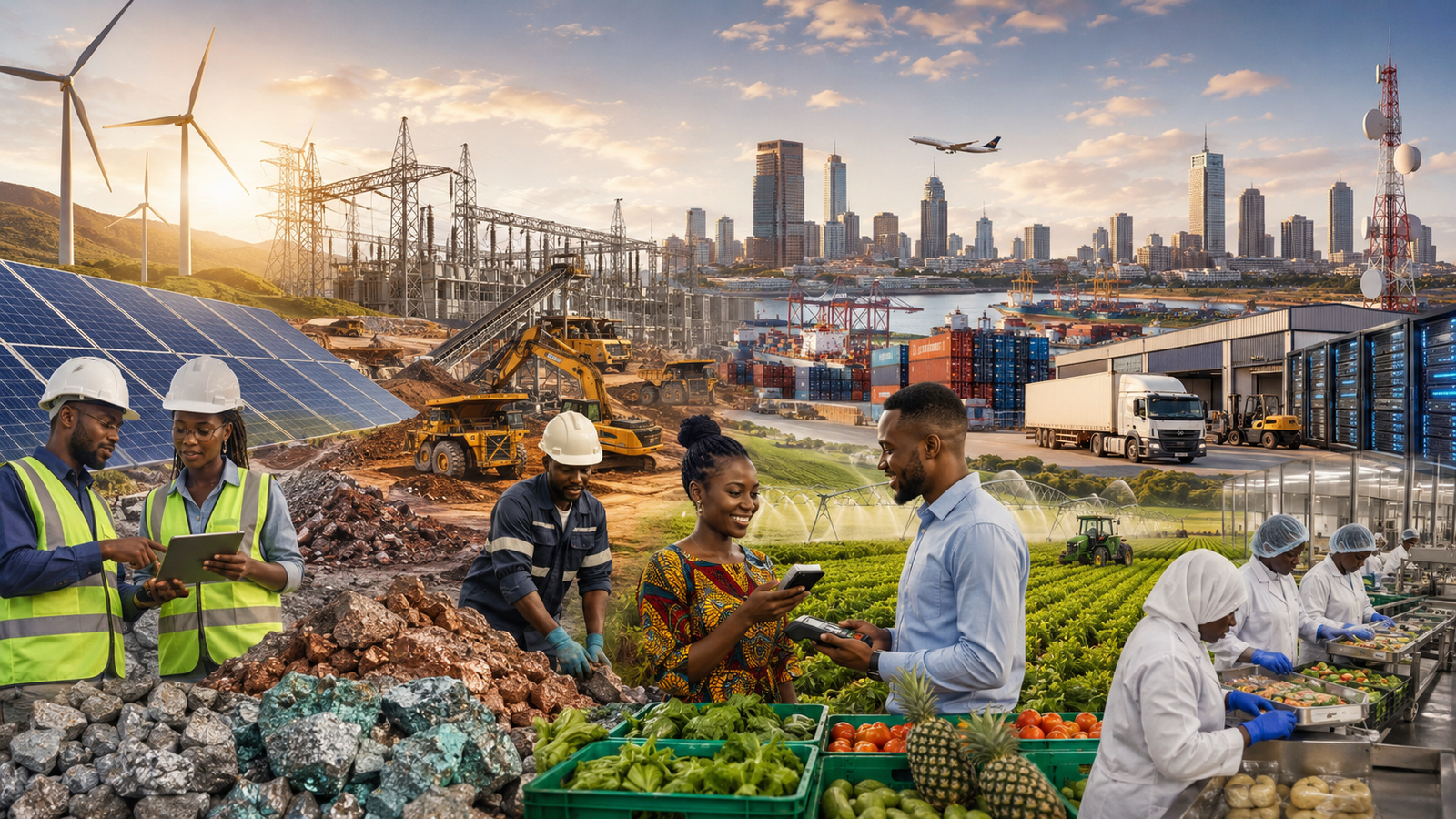
5 African Investment Sectors to Watch in 2026–2027
Where is investment opportunity growing fastest in Africa heading into 2026–2027?
Africa’s investment story is becoming more sophisticated.
The continent still offers opportunities in familiar areas such as natural resources, agriculture and consumer markets, but a deeper transformation is taking place underneath those headlines.
Growing electricity demand is creating new energy markets. Global competition for strategic minerals is increasing interest in African supply chains. Mobile money and digital finance continue to reshape commerce. Food security is pushing agriculture toward greater commercialization and value addition. At the same time, data centres, fibre networks, ports, warehouses and logistics corridors are becoming increasingly important infrastructure for a more connected African economy.
The result is an investment landscape where some of the strongest opportunities may emerge not from a single sector, but from the infrastructure connecting several sectors together.
Africa attracted approximately US$70 billion in foreign direct investment in 2025, according to UN Trade and Development. Although that was below the unusually high level recorded in 2024, it was still roughly one-third above Africa’s long-term average and the third-highest annual level since 1990.
More importantly, UNCTAD says investment is increasingly concentrating around strategic industries including energy, infrastructure, critical minerals and selected manufacturing, while Gulf and Asian investors are becoming more important sources of capital for African projects.
For businesses, investors, institutions and diaspora entrepreneurs looking toward Africa in 2026 and 2027, five sectors deserve particularly close attention.
1. Renewable Energy & Power Infrastructure
Africa’s electricity gap is also one of its largest investment opportunities
Few sectors illustrate Africa’s development challenge—and investment opportunity—as clearly as electricity.
The continent contains some of the world’s strongest solar resources, significant wind corridors, major hydropower potential and growing opportunities in geothermal and other renewable technologies.
Yet reliable and affordable electricity remains unavailable to hundreds of millions of Africans.
That gap affects almost everything else.
Factories need electricity.
Cold-storage facilities need electricity.
Hospitals need electricity.
Telecommunications networks need electricity.
Data centres need electricity.
Irrigation systems need electricity.
Hotels, shopping centres, offices and housing developments all require reliable power.
This makes energy more than a standalone investment sector.
Energy is foundational economic infrastructure.
Where the opportunities are emerging
The investment opportunity extends well beyond building large solar farms.
Potential areas include:
- Utility-scale solar
- Wind farms
- Hydropower
- Geothermal energy
- Solar mini-grids
- Commercial and industrial solar
- Battery energy storage
- Transmission infrastructure
- Distribution networks
- Substations and transformers
- Smart metering
- Grid-management technology
- Energy-efficiency services
- Renewable-powered industrial parks
- Renewable-powered irrigation
- Clean-energy systems for telecom towers
- Green hydrogen in markets where economics and infrastructure support it
One particularly important opportunity is commercial and industrial energy.
A factory, hotel, hospital, warehouse, shopping centre or telecommunications company paying high electricity prices may have a strong economic incentive to install dedicated solar generation and battery storage.
This creates opportunities for companies that can finance, install, maintain and operate distributed energy systems rather than relying entirely on traditional centralized utilities.
The infrastructure around energy may be as valuable as generation itself
Solar panels tend to attract the most attention.
But Africa cannot create modern electricity markets without:
Transmission lines
Electricity has to move from generation sites to demand centres.
Distribution systems
Cities require transformers, substations, cables and modern networks.
Battery storage
Increasing renewable penetration creates demand for storage and grid-balancing technology.
Digital energy systems
Smart meters, billing systems and grid-monitoring platforms are increasingly important.
Financing
Renewable projects often require significant upfront investment despite relatively low operating costs.
This creates opportunities for infrastructure funds, development-finance institutions, local banks, equipment suppliers, energy-service companies and project developers.
Where investors should look
Some of the most interesting African energy markets are likely to be those where three factors overlap:
Strong renewable resources + expensive existing electricity + rapidly growing commercial demand.
Countries across East Africa, Southern Africa, West Africa and the Horn increasingly meet at least some of these conditions.
The opportunity will not be identical everywhere.
Some markets are ready for large utility-scale projects.
Others may be more suitable for smaller mini-grids, commercial solar or captive power systems.
What investors should watch
Successful projects require more than sunlight or wind.
Investors should examine:
- Electricity regulation
- Power-purchase agreements
- Off-taker credit quality
- Tariff structures
- Land access
- Currency exposure
- Transmission availability
- Political risk
- Project preparation quality
- Financing structure
Africa’s renewable resources are enormous.
The commercial opportunity lies in converting those resources into bankable electricity projects.
2. Critical Minerals & Value-Added Processing
Africa sits at the centre of the global race for strategic resources
The transition toward electric vehicles, renewable energy, batteries, advanced electronics, artificial intelligence infrastructure and modern defence and industrial systems is increasing demand for strategic minerals.
Africa possesses major deposits of minerals including:
- Copper
- Cobalt
- Lithium
- Graphite
- Manganese
- Platinum-group metals
- Rare earth elements
- Nickel
- Bauxite
- And other industrial minerals
UNCTAD’s World Investment Report 2026 highlights Africa’s strong position across copper, cobalt, lithium, manganese, graphite, platinum-group metals and rare earth resources.
This gives African countries an important position within changing global supply chains.
But the most significant opportunity may not simply be extracting more minerals.
The bigger opportunity is value addition
For decades, many African economies have exported raw or minimally processed commodities while much of the higher-value processing took place elsewhere.
That model leaves considerable economic value outside the continent.
Consider the difference between exporting:
raw lithium ore
and developing:
lithium processing → battery materials → battery components → energy-storage systems.
Or between exporting:
copper concentrate
and developing:
refined copper → cables → transformers → electrical components → industrial equipment.
The same principle applies beyond minerals.
A country can produce enormous quantities of cocoa, coffee, cashews, cotton, shea or agricultural commodities while capturing relatively little value if processing, packaging, certification, logistics and international distribution happen elsewhere.
Africa’s “missing middle”
One of the strongest observations about African investment is that the opportunity often lies between production and the final market.
That middle layer includes:
- Mineral beneficiation
- Refining
- Industrial processing
- Manufacturing
- Testing laboratories
- Certification
- Warehousing
- Export logistics
- Industrial parks
- Equipment maintenance
- Packaging
- Transport
- Supplier development
- Technical training
This is where investment can potentially generate substantially more local employment and economic spillover than extraction alone.
Why industrial infrastructure matters
Processing minerals locally requires more than building a refinery.
Investors need:
- Reliable electricity
- Water
- Roads
- Railways
- Ports
- Industrial land
- Skilled workers
- Stable regulation
- Environmental compliance
- Predictable taxation
- Export infrastructure
This means critical-mineral investment connects directly with energy, logistics and industrial-development investment.
A copper project may therefore create opportunities for:
power generation → logistics → processing → industrial parks → manufacturing → export infrastructure.
What investors should watch
The biggest question is whether African countries can convert geological advantages into competitive industrial ecosystems.
Investors should monitor:
- Local beneficiation policies
- Mining codes
- Export restrictions
- Infrastructure development
- Electricity availability
- Processing incentives
- Regional trade agreements
- ESG and environmental requirements
- Partnerships with international manufacturers
The long-term opportunity is not simply:
“Mine more minerals.”
It is:
“Capture more of the value chain.”
3. Fintech & Digital Financial Services
Africa’s digital-finance story is far from finished
Fintech has already become one of Africa’s most visible technology sectors.
But the next phase may look very different from the first.
The early fintech wave focused heavily on:
- Mobile wallets
- Digital payments
- Remittances
- Consumer transfers
The next generation increasingly includes:
- SME finance
- Payment infrastructure
- Merchant payments
- Embedded finance
- Digital insurance
- Cross-border payments
- Banking infrastructure
- Alternative credit scoring
- Payroll technology
- Digital identity
- API-based financial services
- Supply-chain finance
Mobile money remains central to this transformation.
GSMA reported that mobile-money services globally processed more than US$2 trillion in transactions during 2025, with Sub-Saharan Africa accounting for much of the growth in new registered and active accounts.
Earlier GSMA data showed Sub-Saharan Africa alone had more than 1.1 billion registered mobile-money accounts and approximately US$1.1 trillion in transaction value during 2024.
The scale is enormous.
The next opportunity is moving beyond payments
Sending money from one phone to another solved an important problem.
But digital financial infrastructure can do much more.
A small retailer accepting digital payments creates transaction records.
Those records may eventually help the retailer qualify for working capital.
The same payment platform could then provide:
- Inventory financing
- Insurance
- Savings
- Supplier payments
- Payroll
- Accounting
- Credit
- Merchant services
One digital relationship can therefore expand into a wider financial ecosystem.
SME finance remains a major opportunity
Africa’s small and medium-sized businesses often struggle to obtain affordable financing.
Traditional lenders may require:
- Formal financial statements
- Property collateral
- Long banking histories
- Extensive documentation
Many legitimate African SMEs cannot meet those requirements.
Digital transaction data and alternative financial information may help lenders assess businesses more effectively.
That creates opportunities in:
Alternative credit scoring
Using legitimate business and transaction data to improve lending decisions.
Embedded finance
Providing financial services directly inside other business platforms.
Supply-chain financing
Financing distributors, merchants and suppliers based on commercial relationships and transaction history.
Invoice financing
Allowing businesses to receive working capital against legitimate receivables.
Digital bookkeeping
Helping informal and semi-formal businesses develop better financial records.
Cross-border payments could become one of the largest opportunities
Africa’s fragmented financial architecture remains an obstacle to regional trade.
The continent contains dozens of:
- Currencies
- Banks
- Payment networks
- Mobile-money systems
- Regulations
As the African Continental Free Trade Area develops, businesses will increasingly require easier ways to move money across borders.
Infrastructure enabling:
local payment → currency conversion → regional settlement → supplier payment
could become extremely valuable.
Digital finance increasingly supports the real economy
Fintech should not be viewed separately from other sectors.
It can finance:
farmers.
It can pay employees.
It can insure shipments.
It can finance solar installations.
It can help SMEs purchase inventory.
It can facilitate cross-border trade.
That makes financial technology part of Africa’s wider economic infrastructure.
4. Agritech & Agribusiness
Africa’s food challenge is becoming an investment challenge
Agriculture remains one of Africa’s most important economic sectors.
But the opportunity is evolving beyond simply increasing farm production.
Population growth, urbanization, changing consumer demand, climate pressure and food-import dependence are forcing countries to rethink entire food systems.
In 2026, FAO and other regional institutions continued calling for significantly greater investment across African agrifood systems.
A joint FAO, African Union, ECA and WFP assessment published in April 2026 highlighted a major financing gap—particularly for agricultural SMEs that often find themselves too large for microfinance but too small or risky for conventional bank lending.
This financing gap creates opportunities.
But capital is needed across the entire value chain.
The opportunity begins before the farm
Agriculture requires:
- Seeds
- Fertilizer
- Irrigation
- Equipment
- Finance
- Insurance
- Technology
- Extension services
Companies improving productivity before and during production can build significant businesses.
But some of the greatest opportunities begin after harvest
Africa loses enormous amounts of economic value when agricultural products cannot be stored, processed or transported efficiently.
That creates opportunities in:
Cold storage
Reducing spoilage for vegetables, fruit, dairy, meat and fish.
Warehousing
Allowing producers and traders to store commodities professionally.
Food processing
Turning raw agricultural products into higher-value consumer and industrial products.
Packaging
Meeting domestic and export-market standards.
Logistics
Connecting farms with cities, processors, ports and retailers.
Quality testing and certification
Helping products meet regional and international requirements.
Processing could transform the economics of agriculture
Consider a country producing tomatoes.
The opportunity is not limited to selling fresh tomatoes.
The wider value chain includes:
tomato production → aggregation → sorting → cold storage → processing → sauce/paste → packaging → wholesale → supermarkets → export.
The same principle applies to:
- Coffee
- Cocoa
- Cashews
- Sesame
- Maize
- Rice
- Poultry
- Fish
- Livestock
- Dairy
- Fruits
- Vegetables
- Shea
- Cassava
This is why agribusiness investment increasingly overlaps with manufacturing.
Agriculture also connects with energy
Modern food systems require reliable electricity.
Cold-storage facilities need power.
Irrigation pumps need power.
Processing plants need power.
Packaging factories need power.
That makes renewable energy potentially transformative for rural economies.
A solar-powered irrigation system or cold-storage facility can therefore become both an energy investment and an agricultural investment.
Agriculture connects with finance too
Digital platforms increasingly allow farmers and agribusinesses to:
- Receive payments
- Access loans
- Purchase inputs
- Buy insurance
- Sell produce
- Track inventory
- Connect with buyers
This creates another convergence between agritech and fintech.
Where investors should look
Instead of focusing only on primary farming, investors should examine the infrastructure surrounding agriculture:
Production → aggregation → storage → processing → logistics → distribution → export.
Often, the most defensible businesses will operate somewhere along that chain rather than owning farmland alone.
5. Digital Infrastructure & Logistics
Africa’s digital economy cannot scale without physical infrastructure
Every online transaction ultimately depends on physical systems.
Cloud services require data centres.
Mobile connectivity requires towers and fibre.
E-commerce requires warehouses.
Digital payments require telecom infrastructure.
Cross-border commerce requires ports and logistics.
Artificial intelligence requires computing capacity and reliable electricity.
The growth of Africa’s digital economy is therefore creating an equally important infrastructure opportunity.
GSMA reported that mobile technologies and services contributed approximately US$240 billion to Africa’s economy in 2025, equivalent to 7.8% of the continent’s GDP.
GSMA expects this contribution to increase to approximately US$290 billion by 2030.
Yet major infrastructure gaps remain.
Almost one billion Africans were still not using mobile internet in 2025, despite substantial network coverage.
This demonstrates both the progress already made and the scale of the remaining opportunity.
Data centres
Africa generates increasing volumes of digital information.
Businesses are adopting:
- Cloud software
- Digital banking
- Artificial intelligence
- Streaming
- E-commerce
- Enterprise technology
All of this creates demand for computing infrastructure.
The opportunity includes:
- Hyperscale data centres
- Colocation facilities
- Edge computing
- Cloud infrastructure
- Backup systems
- Cooling technology
- Cybersecurity
- Renewable energy for data centres
Data centres are particularly interesting because they sit at the intersection of several sectors:
technology + real estate + electricity + telecommunications + infrastructure finance.
Fibre networks
Reliable broadband remains essential for digital economic development.
Investment opportunities include:
- National fibre networks
- Metropolitan fibre
- Submarine cables
- Cross-border connectivity
- Last-mile broadband
- Enterprise connectivity
As more businesses digitize, broadband becomes economic infrastructure rather than simply a consumer service.
Logistics: the physical infrastructure behind trade
Africa’s logistics challenge is equally significant.
A company may successfully manufacture a product but still struggle to deliver it economically.
Problems can include:
- Poor roads
- Limited warehousing
- Fragmented trucking
- Border delays
- Customs complexity
- Port congestion
- Limited cold chains
Every inefficiency raises costs.
That creates opportunity.
Warehousing and fulfilment
Growing cities and digital commerce require modern warehouses.
Businesses increasingly need facilities providing:
- Inventory management
- Fulfilment
- Cold storage
- Cross-docking
- Distribution
- Packaging
- E-commerce logistics
Industrial real estate may therefore become an increasingly important African asset class.
Ports and economic corridors
Major African port and transport investments can reshape entire regions.
A port is rarely just a port.
It can create demand for:
port → warehousing → trucking → customs services → industrial parks → wholesale markets → manufacturing → housing → financial services.
This is why investors should watch not only cities but economic corridors.
Infrastructure linking inland production areas to regional and international markets can create development opportunities far beyond the immediate transport asset.
AfCFTA makes logistics even more important
Africa’s long-term economic opportunity depends partly on increasing trade between African countries.
A business in Kenya should increasingly be able to sell into Uganda, Tanzania, Rwanda, Zambia, DRC and beyond.
A manufacturer in Ghana should be able to access wider West African markets.
But trade agreements cannot solve logistical problems alone.
Goods still need to move physically.
That requires:
- Ports
- Roads
- Rail
- Warehouses
- Freight systems
- Customs technology
- Payment infrastructure
Recent World Bank analysis on African economic integration emphasizes exactly this connection: regional value chains can connect mineral extraction with manufacturing, agriculture with food industries, renewable power with industrial hubs, and transport and digital services with firms across the continent.
That may be one of Africa’s most important investment themes over the coming decade.
The Bigger Opportunity Is Where These Five Sectors Connect
Looking at these sectors separately risks missing the most interesting part of the African investment story.
They increasingly reinforce one another.
Energy powers industry
Cheap and reliable electricity enables:
- Manufacturing
- Mining
- Data centres
- Cold storage
- Agriculture
- Logistics
- Digital infrastructure
Without energy, the competitiveness of almost every other sector suffers.
Minerals support industrialization
Minerals feed:
- Batteries
- Renewable-energy equipment
- Electronics
- Construction
- Transportation
- Manufacturing
But local processing can capture significantly more economic value than raw commodity exports alone.
Digital finance moves capital
Digital financial infrastructure allows:
- SMEs to receive payments
- Farmers to access finance
- Workers to receive salaries
- Businesses to transact across borders
- Consumers to participate in formal markets
Financial infrastructure is therefore one of the systems connecting economic activity.
Agriculture supplies growing cities
Africa’s urban population will continue increasing.
Growing cities require enormous quantities of:
- Food
- Water
- Housing
- Energy
- Transportation
- Consumer goods
Agriculture therefore becomes closely connected with urbanization, logistics, processing and retail.
Logistics connects everything
Resources have little economic value if they cannot reach markets efficiently.
A farmer needs access to processors.
Factories need raw materials.
Retailers need warehouses.
Exporters need ports.
Digital commerce needs delivery networks.
Logistics provides the connective tissue.
The Investment Opportunity May Be in the “Missing Middle”
One of the most important lessons for investors looking at Africa is that the opportunity does not always sit at either end of a value chain.
It may sit in the middle.
Africa produces enormous quantities of:
- Minerals
- Agricultural commodities
- Energy resources
- Entrepreneurial ideas
- Digital transactions
But value is often lost where infrastructure between production and the final customer is missing.
Consider cocoa:
farm → aggregation → quality control → storage → processing → chocolate manufacturing → packaging → distribution → export.
Consider copper:
mine → processing → refining → electrical components → manufacturing → regional distribution.
Consider fisheries:
boat → cold storage → processing → packaging → transport → supermarket/export.
Those middle stages can generate:
- Jobs
- Manufacturing
- Tax revenue
- Export earnings
- Technology transfer
- Local supplier development
The investment opportunity therefore increasingly becomes:
How do we build the missing infrastructure that turns African production into market-ready products?
Africa’s Investment Story Is Becoming More Regional
Another structural shift is occurring.
Investors increasingly need to think beyond individual national markets.
A project may be located in one country but serve a regional market.
Examples could include:
- A data centre serving several countries
- A port supporting a landlocked neighbour
- A refinery sourcing minerals across borders
- A payment platform connecting multiple currencies
- A food-processing plant sourcing crops regionally
- A power project eventually participating in regional electricity trade
This is where the African Continental Free Trade Area becomes strategically important.
Africa’s individual economies vary significantly in size.
Regional markets can create the scale that industries need to become competitive.
Where Is Capital Coming From?
Africa’s investment relationships are also becoming more diversified.
Traditional investors from:
- Europe
- North America
- Multilateral development institutions
remain important.
But investment from:
- Gulf states
- China
- India
- Türkiye
- Other Asian economies
- African institutional investors
- Sovereign wealth funds
- Private equity
- Diaspora investors
is increasingly shaping infrastructure and industrial investment.
UNCTAD’s 2026 assessment specifically points to the growing role of Gulf and other Asian investors in African energy, logistics, infrastructure and real estate.
This creates more competition for African opportunities—and potentially more financing options for well-prepared projects.
Development Finance Will Remain Critical
Private capital will not finance every African project on its own.
Many projects face:
- Political risk
- Currency risk
- Early-stage development risk
- Weak off-takers
- Limited infrastructure
- High upfront costs
Development-finance institutions can therefore play a crucial role.
Investment structures may combine:
Private equity + development finance + concessional debt + grants + guarantees + government participation.
This blended-finance approach can help turn economically important but difficult projects into commercially investable opportunities.
What Makes an African Opportunity Investable?
Natural resources alone are not enough.
Population growth alone is not enough.
Demand alone is not enough.
Investors require projects that are professionally structured.
That generally means answering questions such as:
- What exactly is being built?
- Who is the customer?
- How large is the market?
- Who are the competitors?
- What is the revenue model?
- What licenses are required?
- What infrastructure is available?
- What are the risks?
- Who owns the project?
- Who is the management team?
- How much capital is needed?
- What returns might investors reasonably expect?
- What is the exit strategy?
This is why project preparation may itself become one of Africa’s major business opportunities.
The continent does not suffer from a shortage of ideas.
Often, it suffers from a shortage of investment-ready projects.
From Opportunity to Execution
Africa’s next growth cycle will probably not be built around one sector alone.
It will be built where sectors intersect.
Imagine a regional agricultural processing hub.
It could require:
☀️ Renewable energy to power the facility
🌾 Farms to produce raw materials
🏭 Processing equipment to create finished products
📱 Digital finance to pay farmers and suppliers
❄️ Cold storage to preserve products
🏗️ Warehouses for inventory
🚛 Logistics to move products
🚢 Ports to reach export markets
💻 Digital infrastructure to manage supply chains
💰 Investment capital to finance expansion
That is one investment ecosystem.
And it illustrates why investors need to look beyond individual opportunities toward the economic systems being built around them.
Five African Investment Themes to Watch in 2026–2027
⚡ 1. Renewable Energy & Power Infrastructure
Watch opportunities in generation, battery storage, mini-grids, transmission, commercial solar and industrial energy.
⛏️ 2. Critical Minerals & Value-Added Processing
Watch the transition from raw mineral exports toward refining, processing, manufacturing and regional industrial value chains.
📱 3. Fintech & Digital Financial Services
Watch payments infrastructure, cross-border finance, SME lending, embedded finance, insurance and alternative credit systems.
🌾 4. Agritech & Agribusiness
Watch food processing, irrigation, storage, cold chains, agricultural finance, logistics and technology improving productivity.
🏗️ 5. Digital Infrastructure & Logistics
Watch data centres, fibre networks, industrial warehouses, fulfilment facilities, ports, trade corridors and cross-border logistics.
The Bigger Question for Investors
The important question is no longer simply:
“Which African sector will grow fastest?”
A better question may be:
“Where is infrastructure being built that allows several sectors to grow together?”
Where is electricity becoming more reliable?
Where are new ports and trade corridors emerging?
Where is industrial processing increasing?
Where are governments improving investment frameworks?
Where are regional markets becoming more connected?
Where is private capital already beginning to move?
And where are important economic problems still unsolved?
That is often where the strongest long-term opportunities begin.
Africa’s opportunity is significant—but serious investors should distinguish between potential and investability.
The best markets will not necessarily be the ones with the loudest headlines.
They may be the markets where resources, infrastructure, policy, demand, capital and local execution finally begin to align.
About Afrobees
AFROBEES DEVELOPMENT & INVESTMENT LTD.
Afrobees is a Pan-African business, investment, trade and development firm focused on helping businesses, investors, institutions and diaspora communities identify opportunities, understand African markets, develop projects, establish strategic partnerships and move from opportunity to execution.
We follow the sectors, markets, projects and economic trends shaping Africa’s next phase of growth.
Connecting Africa. Empowering Business. Driving Investment.
📞 +1 (403) 646-0513
💬 WhatsApp: +1 (403) 646-0513
Disclaimer: This article is provided for general market intelligence and informational purposes only. It does not constitute financial, legal or investment advice. Investment conditions differ considerably across African countries and projects. Investors should conduct independent financial, legal, regulatory, technical and market due diligence before making investment decisions.