
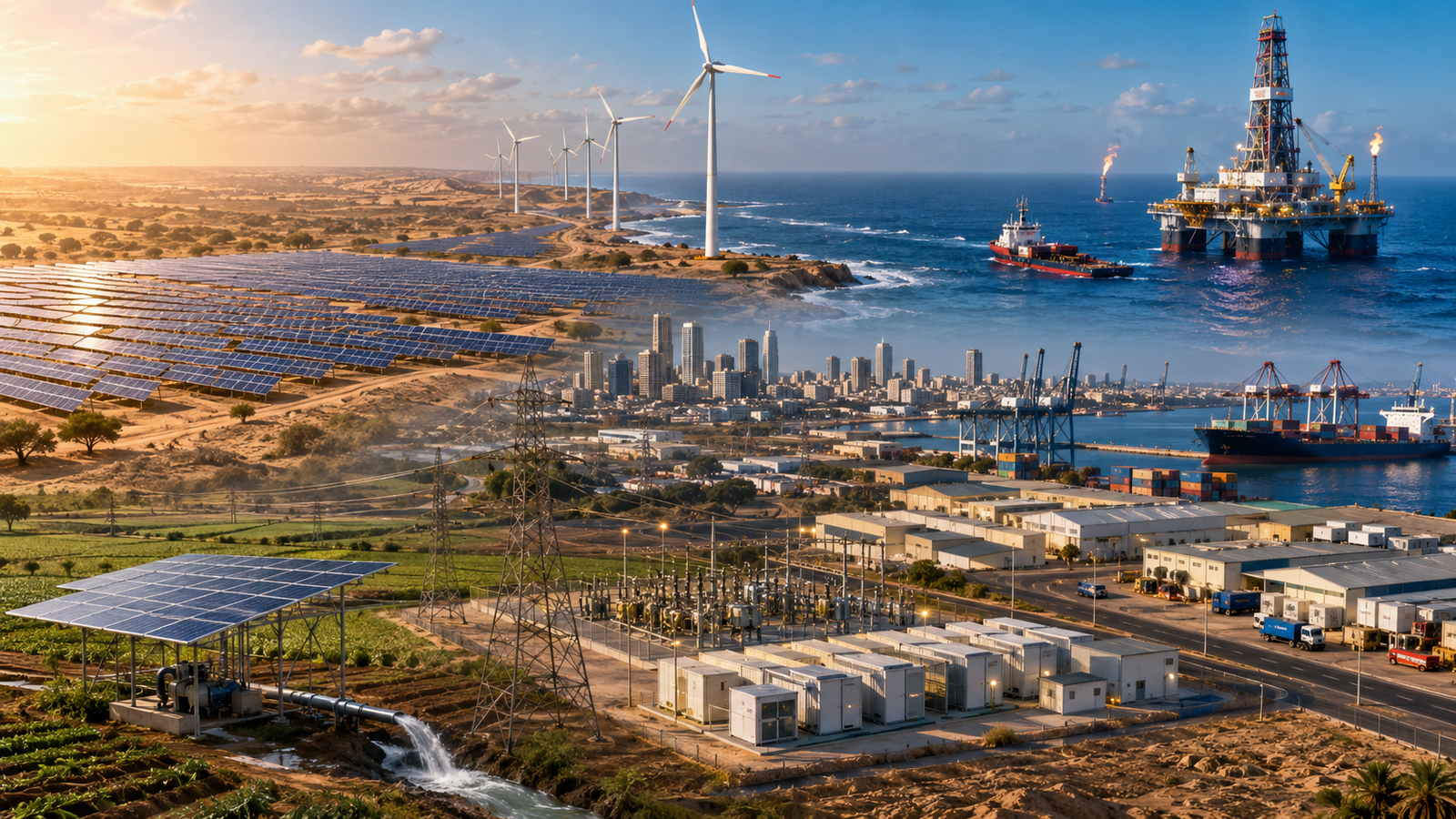
Somalia’s Emerging Energy Opportunity: Solar, Wind, Infrastructure and the Search for Oil & Gas
Somalia may be sitting on one of Africa’s most overlooked energy opportunities. But the biggest investment story may not be a single oil discovery or a giant wind farm. It may be the transformation of an entire energy system.
For decades, international perceptions of Somalia have been dominated by conflict, humanitarian crises, political instability and institutional weakness. Those challenges remain important. Yet beneath that familiar narrative, another Somalia is gradually becoming visible: a country with exceptional solar resources, significant wind potential, a large unmet electricity market, an expanding private energy sector and offshore petroleum acreage that has moved from seismic surveying into actual deepwater drilling.
In 2026, the energy story is becoming especially difficult to ignore.
Somalia is simultaneously trying to modernize an electricity system built largely around isolated diesel-powered networks, scale renewable generation, establish stronger energy regulation, attract infrastructure financing and determine whether its offshore geology contains commercially recoverable hydrocarbons.
That combination creates opportunity—but also requires a much more careful analysis than simply describing Somalia as an “energy-rich country.”
The resources are promising. The electricity demand is real. The market gaps are substantial. But much of the opportunity still needs to be measured, financed, structured, regulated and converted into bankable projects.
Somalia’s Energy Opportunity Is Bigger Than Oil
When Somalia’s energy potential is discussed internationally, attention often turns immediately to offshore oil.
That is understandable.
The Somali Petroleum Authority currently identifies approximately 30 billion barrels as potential petroleum resources/reserves, while the U.S. International Trade Administration similarly notes that geological and seismic studies have suggested resources of at least 30 billion barrels of oil and gas. The African Development Bank has also cited a 2020 estimate by geoscience company TGS suggesting the Somali offshore basin could contain around 30 billion barrels.
But one distinction is essential:
30 billion barrels should not be presented as 30 billion barrels of proven oil reserves.
Somalia has not yet established commercially recoverable reserves on that scale. Even the Federal Ministry of Petroleum has emphasized that the country’s priority is to prove whether hydrocarbon accumulations exist and establish their commercially recoverable size.
That makes Somalia a frontier exploration market, not yet an established petroleum producer.
And while hydrocarbons could become highly significant if commercial discoveries are confirmed, Somalia’s near- and medium-term energy opportunity is already much broader.
It includes:
- solar power;
- wind generation;
- battery energy storage;
- hybrid diesel-renewable plants;
- mini-grids;
- transmission and distribution;
- smart metering;
- commercial and industrial power;
- rural electrification;
- cold-storage and productive-use systems;
- cross-border electricity trade;
- energy services and maintenance;
- and potentially, over the longer term, an entirely new petroleum value chain.
1. Offshore Oil Exploration Has Entered a New Phase
Somalia’s petroleum story has moved significantly beyond speculation and old geological maps.
The country has accumulated tens of thousands of kilometres of modern offshore seismic data. TGS said in late 2025 that its Somali database included more than 46,000 line-kilometres of modern 2D seismic data and over 50,000 kilometres of aeromagnetic data, covering highly underexplored offshore basins.
More recently, cooperation between Somalia and Türkiye has accelerated exploration.
Türkiye’s Oruç Reis seismic vessel conducted a 234-day campaign in Somali waters after arriving in October 2024. The vessel collected 3D seismic data across approximately 4,464 square kilometres in three offshore blocks before completing the survey in 2025.
The next—and much more consequential—stage began in 2026: drilling.
Türkiye deployed the Çağrı Bey deepwater drilling vessel to drill the Curad-1 exploration well, approximately 372 kilometres offshore from Mogadishu. Somali officials said in August 2026 that drilling had progressed to roughly 3,000 metres and could potentially be completed by the end of September.
As of early September 2026, however, no commercially proven discovery from that drilling campaign has yet been publicly confirmed.
That distinction matters enormously for investors.
Seismic prospects are not discoveries.
Discoveries are not automatically commercial reserves.
Commercial reserves do not automatically become profitable producing fields.
Offshore exploration requires discovery wells, appraisal, reservoir analysis, commercial evaluation, environmental assessments, engineering, infrastructure, financing and—if everything works—eventual field development.
In a frontier deepwater basin, this can take years and billions of dollars.
Nevertheless, moving from seismic mapping to an actual exploration well represents one of the most significant milestones in Somalia’s modern petroleum history.
2. What Happens If Commercial Oil or Gas Is Found?
A significant discovery would create opportunities far beyond simply exporting crude oil.
An emerging petroleum industry could eventually generate demand for:
Marine and offshore services
Supply vessels, port logistics, equipment storage, marine support and offshore maintenance could become important supporting industries.
Engineering and technical services
Exploration and production require geologists, engineers, environmental specialists, drilling technicians, surveyors, safety professionals and project managers.
Ports and logistics
Large offshore developments require sophisticated supply chains connecting ports, airports, storage areas and offshore installations.
Local workforce development
Technical colleges, vocational training providers and universities could eventually develop petroleum-related skills programs.
Professional services
Accounting, legal, insurance, environmental consulting, recruitment, security, logistics, procurement and compliance services would all become part of the supporting ecosystem.
Infrastructure
Roads, telecommunications, ports, power systems, storage facilities and industrial areas frequently develop around major energy investments.
But there is another side to the opportunity.
Resource discoveries can produce poor economic outcomes if institutions, transparency, environmental protections and revenue governance are weak.
Somalia has established a Petroleum Law, regulatory structures and a petroleum revenue-sharing framework intended to distribute future petroleum benefits among the federal government, Federal Member States and communities.
The strength and credibility of those institutions will become increasingly important if commercially recoverable resources are proven.
For Somalia, therefore, the real petroleum question is not simply:
“Is there oil?”
It is also:
“Can petroleum development be governed in a way that produces long-term national economic value?”
3. Solar May Be Somalia’s Most Immediate Energy Opportunity
While offshore oil captures headlines, solar energy may provide a much faster route to economic impact.
Somalia has exceptionally strong solar resources.
IRENA’s 2025 Energy Transition Assessment for Somalia reports average solar irradiation of approximately 6–8 kWh per square metre per day. Somalia’s investment promotion agency separately reports around 5–7 kWh/m²/day, more than 310 sunny days and approximately 3,000 hours of sunshine annually.
Academic research covering Somali regions between 2010 and 2020 similarly found strong irradiation across the country, including measurements exceeding 6.6 kWh/m²/day in several northern regions.
This provides an important natural advantage.
But the economics are perhaps even more important than the sunlight.
Somalia’s electricity market remains heavily exposed to imported diesel.
IRENA estimates electricity tariffs in Somalia at roughly US$0.40–$1.00 per kWh, compared with a Horn of Africa average previously estimated around $0.22/kWh.
For businesses operating refrigeration systems, factories, hotels, hospitals, telecommunications equipment, water pumps, workshops, offices or digital infrastructure, electricity can therefore become a major operating expense.
Solar changes that equation.
4. Somalia Is Already Demonstrating That Hybridization Can Reduce Costs
Renewable power in Somalia is not entirely theoretical.
One of the strongest indicators comes from previous World Bank-supported hybridization programs.
Nine hybrid mini-grids received financing for approximately 5.7 MWp of solar photovoltaic capacity and 2.6 MWh of battery storage. According to World Bank project documentation, the intervention reduced diesel consumption by roughly 3.4 million litres per year, while eight of the nine electricity service providers reduced tariffs by approximately 34%.
That is important evidence.
It suggests that one of Somalia’s most commercially realistic energy strategies is not necessarily replacing the existing electricity industry.
It is transforming it.
Private electricity companies already have:
- customers;
- distribution networks;
- billing relationships;
- local operational experience;
- generators;
- technicians;
- and established electricity demand.
Adding solar, wind, batteries, smart meters and improved grid management to those networks can reduce fuel consumption and potentially improve reliability.
That creates a very different investment proposition from trying to build an entirely new electricity market from scratch.
5. Wind Could Become the Second Major Renewable Pillar
Somalia also possesses some of Africa’s strongest wind resources.
The U.S. International Trade Administration cites studies suggesting potential onshore wind generation capacity of approximately 30,000–45,000 MW, adding that earlier research concluded wind conditions could be suitable for power production across a large part of the country.
Somalia’s Ministry of Energy and Water Resources reports annual wind speeds exceeding 8 metres per second in many regions, although actual commercial wind projects require detailed site-level measurements before investment decisions can be made.
Existing projects demonstrate that wind can be incorporated into Somali electricity systems.
Garowe, for example, has operated hybrid renewable generation combining solar and wind alongside conventional generation.
The strategic opportunity could be particularly important across northern and coastal Somalia, where strong wind corridors overlap with expanding towns, ports and potential industrial development.
However, large-scale wind development is more technically demanding than simply identifying strong average wind speeds.
Investors will need:
- bankable wind measurements;
- land and permitting arrangements;
- grid connections;
- environmental assessments;
- power-purchase agreements;
- transmission capacity;
- financing;
- and credible long-term off-takers.
Therefore, Somalia’s headline 30–45 GW wind potential should be understood as technical/resource potential—not immediately investable generation capacity.
The task is converting that resource potential into specific bankable sites.
6. The Real Opportunity Is Somalia’s Electricity Deficit
Perhaps the strongest investment case is not Somalia’s resource abundance at all.
It is the shortage of affordable, reliable electricity.
Somalia currently has no fully interconnected national transmission grid. Electricity has historically developed through fragmented, privately operated systems serving individual cities and communities.
Private providers supply more than 90% of electricity in urban and peri-urban markets, typically through isolated networks originally built around diesel generators.
Recent World Bank evidence paints a particularly revealing picture.
A 2025 Multi-Tier Framework survey cited by the World Bank’s 2026 Somalia Economic Update found that approximately 71% of households reported some form of electricity access—but only 21% received more than eight hours of supply per day.
That difference between connection and reliable electricity is critical.
A house can technically have electricity access while still experiencing limited supply, expensive tariffs or insufficient power for productive economic activity.
For investors, that means the opportunity is not simply connecting the unconnected.
It is also improving the quality, reliability and affordability of the connections that already exist.
7. The Investment Opportunity May Be in the Grid Itself
Solar panels receive attention because they are visible.
But a modern electricity system requires much more.
Somalia needs investment across the full electricity value chain:
Generation
Solar, wind, hybrid generation and potentially other technologies.
Battery Energy Storage Systems
Storage allows solar electricity generated during the day to support evening demand and reduces dependence on diesel generators.
Distribution
Many existing urban distribution networks require modernization, reinforcement and improved technical standards.
Transmission
Eventually, isolated city networks need greater interconnection if Somalia is to create larger and more efficient electricity markets.
Smart Metering
Digital meters can improve billing, identify losses and give utilities better visibility over consumption.
Grid Management
Software, automation and control systems can improve reliability and allow more renewable generation to be integrated.
Substations and Transformers
Urban expansion creates constant demand for new electrical infrastructure.
Regional Interconnection
Somalia may ultimately participate more deeply in the East African electricity market.
In June 2026, the World Bank approved the first phase of the $1.6 billion Regional Energy Transmission, Trade & Decarbonization program for Eastern Africa (RETRADE-EA). The longer-term program is intended to strengthen regional power trade and help integrate countries currently outside the regional grid, including Somalia.
That opens a much bigger strategic possibility.
Somalia’s future electricity system does not necessarily need to remain a collection of isolated urban grids forever.
8. The Policy Environment Is Beginning to Change
Large infrastructure investment requires more than resources.
Investors need rules.
Somalia took an important step in 2023 when the National Electricity Act was signed into law.
The legislation provides a framework for regulating electricity generation, transmission, distribution and consumption while establishing the basis for a national regulatory authority and greater private-sector participation.
International institutions are also supporting sector reform.
The World Bank’s 2025 development-policy financing included measures intended to increase renewable electricity generation, with a target of supporting 50 MW of renewable capacity by December 2026.
Separate programs such as the Somali Electricity Sector Recovery Project and ASCENT Somalia – Accelerating Sustainable and Clean Energy Access Transformation are supporting renewable generation, storage, distribution infrastructure and wider energy-access reforms.
This institutional work is less dramatic than drilling an offshore oil well.
But for investors, it may ultimately be just as important.
9. Where Could the First Investable Opportunities Emerge?
Instead of asking which resource is largest, investors may benefit from asking:
Which opportunities can become commercially viable first?
Several categories stand out.
Solar-Diesel Hybridization
Existing utilities can use solar and storage to reduce diesel consumption rather than immediately abandoning their current infrastructure.
Previous Somali projects already demonstrate this model.
Commercial and Industrial Solar
Large electricity consumers may have compelling incentives to reduce expensive grid and generator consumption.
Potential customers include:
- hotels;
- hospitals;
- supermarkets;
- universities;
- factories;
- warehouses;
- telecom operators;
- offices;
- shopping centres;
- water companies;
- and logistics facilities.
Battery Storage
As solar penetration increases, batteries become increasingly important for evening demand, grid stability and diesel displacement.
Mini-Grids
Remote towns and settlements may be better served by solar-storage mini-grids than by waiting decades for conventional national-grid expansion.
Electricity Distribution Infrastructure
Transformers, substations, cables, smart meters and distribution upgrades represent a major infrastructure market in their own right.
Cold-Chain Energy
Somalia has opportunities in fisheries, livestock, agriculture and food distribution—but those industries require reliable refrigeration.
Energy infrastructure and food-value-chain development therefore reinforce one another.
Water and Solar Pumping
Reliable solar-powered pumping and desalination systems could become increasingly important in water-stressed communities.
Telecom Energy
Telecommunications towers and digital infrastructure require reliable electricity, creating opportunities for dedicated renewable systems and storage.
Wind-Solar Hybrid Plants
Some locations may benefit from complementary solar and wind resources, potentially generating at different times of day and reducing overall storage requirements.
Energy Services
Engineering, installation, operations, maintenance, metering, monitoring and energy-efficiency services could grow alongside physical infrastructure.
10. Energy Could Unlock Somalia’s Productive Economy
The significance of the energy transition extends far beyond electricity.
Affordable and reliable energy determines what types of businesses can operate competitively.
Consider manufacturing.
A manufacturer paying some of the world’s highest electricity tariffs must incorporate that cost into every product it makes.
That makes domestically manufactured products less competitive against imports.
Reduce the electricity cost and the economics of local manufacturing begin to change.
The same applies to:
Fisheries
Ports and fishing communities need ice plants, refrigeration, processing factories and cold storage.
Agriculture
Irrigation, water pumping, storage, processing and packaging depend on energy.
Livestock
Modern slaughterhouses, veterinary facilities, meat processing and cold chains require reliable power.
Digital infrastructure
Data centres, telecommunications towers, fintech infrastructure and cloud-connected businesses require stable electricity.
Healthcare
Hospitals require uninterrupted electricity for equipment, cooling, laboratories and pharmaceutical storage.
Housing
Rapidly expanding cities require electricity infrastructure alongside new residential developments.
Logistics
Warehouses, ports, airports and transport hubs increasingly depend on reliable digital and electrical systems.
Small businesses
From welders and tailors to barbers, workshops, restaurants and retailers, electricity costs directly affect profitability.
This is why Somalia’s energy transformation should not be viewed as an isolated infrastructure sector.
Energy is economic infrastructure.
11. The Energy–Industrialization Connection
This creates a potentially powerful economic cycle.
Cheaper electricity → lower business costs → greater productive investment → more electricity demand → stronger utility revenues → additional infrastructure investment.
Energy development can therefore become a platform for industrial development.
Industrial parks could eventually combine:
- dedicated solar generation;
- battery storage;
- reliable distribution;
- water infrastructure;
- logistics;
- broadband;
- warehouses;
- manufacturing facilities;
- and common business services.
Instead of treating energy, manufacturing and logistics as separate development challenges, they can be designed together.
That approach could be particularly relevant around Somalia’s major urban and transport nodes.
12. Oil and Renewables Do Not Necessarily Represent Opposing Futures
Energy debates are often presented as:
oil versus renewables.
Somalia’s reality is more complicated.
If significant petroleum resources are discovered, hydrocarbons could potentially provide export earnings, fiscal revenues and investment capital.
At the same time, Somalia has every incentive to reduce domestic reliance on expensive imported diesel by developing local renewable electricity.
The two strategies can therefore coexist.
A possible long-term model would be:
Petroleum exports + renewable domestic electricity + modern transmission + productive industrial demand.
If natural gas were discovered commercially, another possibility could eventually emerge: domestic gas-to-power, fertilizer, industrial heat or other value-added applications.
However, these possibilities remain speculative until commercially recoverable resources are established.
Renewable electricity, by contrast, can be expanded today.
13. The Challenges Should Not Be Underestimated
The opportunity is significant precisely because many problems remain unresolved.
Financing
Somali companies often struggle to access affordable long-term capital.
Renewable projects require substantial upfront investment even if operating costs are lower afterward.
Currency and Payment Risk
Financiers need confidence that electricity customers and off-takers can reliably meet payment obligations.
Fragmented Networks
Somalia’s independent electricity systems need technical standardization and eventually greater interconnection.
Regulation
The Electricity Act provides an important foundation, but regulation must continue to be implemented effectively.
Project Preparation
A resource is not a project.
Investors require:
- feasibility studies;
- demand studies;
- environmental assessments;
- financial models;
- land agreements;
- licenses;
- grid studies;
- PPAs;
- technical designs;
- and clearly allocated risks.
Poorly prepared opportunities will struggle to attract serious capital regardless of resource potential.
Security
Security conditions remain uneven across Somalia and materially affect project costs, insurance, financing and international investor appetite.
Institutional Capacity
Energy markets require capable regulators, ministries, utilities and local technical professionals.
Environmental and Community Considerations
Oil, wind, solar and transmission projects all have environmental and community implications that need responsible assessment.
Governance
If petroleum discoveries become commercially significant, transparent management of revenues will become one of Somalia’s most consequential governance challenges.
14. Project Preparation Could Become an Industry of Its Own
This is an overlooked part of Somalia’s investment opportunity.
There may be billions of dollars of potential projects—but capital does not invest in “potential.”
Capital invests in structured opportunities.
An undeveloped idea might say:
“Somalia needs renewable energy.”
An investable project needs to say:
- where;
- how many megawatts;
- what technology;
- who owns the land;
- who buys the electricity;
- at what tariff;
- for how many years;
- what the demand forecast is;
- what licenses are required;
- how much construction costs;
- how much equity is required;
- how much debt is required;
- what the expected return is;
- what environmental risks exist;
- and how political, currency and payment risks will be mitigated.
Bridging the distance between those two stages will be critical.
That creates opportunities for:
- project developers;
- transaction advisers;
- engineering companies;
- financial advisers;
- environmental consultants;
- legal firms;
- market researchers;
- investment facilitators;
- development-finance institutions;
- insurers;
- guarantee providers;
- and local project-development firms.
15. Development Finance Could Play a Major Role
Somalia’s risk profile means some large infrastructure projects may not initially be financed through ordinary commercial capital alone.
Blended finance could become particularly important.
A project might combine:
Sponsor equity
Capital from the project developer.
Commercial debt
Loans from banks or infrastructure lenders.
Development finance
Longer-term capital from DFIs.
Concessional finance
Lower-cost financing designed to improve project economics.
Grants
Funding for feasibility studies, technical assistance or viability-gap support.
Guarantees
Political-risk or credit guarantees that reduce investor exposure.
Public-private partnerships
Government and private investors sharing responsibilities and risks.
World Bank Group institutions are already becoming involved. As of August 2025, MIGA reported exposure in Somalia’s energy sector, demonstrating the potential role of political-risk mitigation in attracting private capital.
These instruments may prove crucial for moving Somalia from small energy projects toward larger infrastructure investment.
16. Somalia Could Eventually Become Part of a Larger Horn of Africa Energy Market
Somalia’s energy story should also be viewed regionally.
The Horn and East Africa are gradually building larger interconnected electricity markets.
Regional transmission could eventually allow countries to:
- export surplus electricity;
- import electricity during shortages;
- balance renewable generation;
- improve grid stability;
- develop larger power projects;
- and lower overall generation costs.
For Somalia, integration would represent a fundamental transition away from isolated city networks toward participation in a regional energy system.
That will not happen overnight.
But the direction matters.
17. What Should Investors Watch Between 2026 and 2030?
Several indicators will help determine whether Somalia’s energy opportunity moves from promise to investment reality.
1. Curad-1 drilling results
Confirmation—or absence—of commercially significant hydrocarbons will substantially change the petroleum outlook.
2. Additional offshore drilling
One well rarely determines the economics of an entire frontier basin.
Further exploration will be crucial.
3. Electricity regulation
Investors should watch implementation of the National Electricity Act and development of the regulatory framework.
4. Renewable capacity additions
The speed at which utilities add solar, wind and storage will demonstrate commercial confidence.
5. Electricity tariffs
Falling tariffs would improve competitiveness throughout the Somali economy.
6. Utility consolidation and interconnection
Connecting fragmented networks could dramatically improve sector efficiency.
7. Battery deployment
Storage will be increasingly important as renewable penetration rises.
8. Development-finance participation
More guarantees, concessional facilities and infrastructure financing could unlock private investment.
9. Transmission development
The transition from isolated urban systems toward interconnected grids will be a defining milestone.
10. Productive energy demand
Factories, cold storage, industrial parks, ports, water infrastructure and digital facilities can provide the anchor demand needed to make larger projects financially viable.
The Bigger Story: From Energy Potential to Economic Infrastructure
Somalia’s energy opportunity is sometimes presented as a resource story:
30 billion barrels.
45 GW of wind potential.
More than 3,000 hours of sunshine.
Those figures attract attention.
But they are not the most important story.
The deeper opportunity is what happens when affordable, reliable energy reaches businesses, factories, farms, ports, hospitals, homes and digital infrastructure.
It means a fish-processing company can operate cold storage.
It means a manufacturer can produce competitively.
It means a hospital can keep critical equipment operating.
It means a farmer can pump water.
It means a telecommunications company can expand infrastructure.
It means cities can support larger commercial and industrial economies.
And it means entrepreneurs can build businesses that are currently uneconomic because electricity is too expensive or unreliable.
That is the real multiplier.
From Potential to Projects
Somalia does not yet have a mature energy market.
That is precisely why the opportunity is so significant—and why investors must remain disciplined.
Its petroleum resources still need to be proven.
Its wind potential needs to be converted into bankable sites.
Its solar advantage needs financing and storage.
Its isolated electricity systems need modernization and interconnection.
Its regulatory institutions need continued strengthening.
Its energy companies need capital.
And many potential infrastructure projects still need professional preparation before institutional investors will consider financing them.
Yet the direction of travel is increasingly visible.
Somalia has moved from offshore seismic speculation to deepwater drilling.
Renewables are moving from pilots toward increasingly mainstream utility generation.
Energy regulation is developing.
International institutions are financing sector reform.
And regional electricity integration is entering the long-term agenda.
Somalia’s energy opportunity can therefore be summarized in three words:
Measured. Mapped. Emerging.
Not fully proven.
Not without risk.
Not yet mature.
But increasingly difficult to ignore.
If Somalia succeeds in converting even a portion of its renewable resources, electricity demand and potential hydrocarbons into responsibly governed, commercially viable projects, the resulting transformation could reach far beyond the energy sector.
It could help create the infrastructure base for manufacturing, fisheries, agriculture, logistics, digital services, housing, healthcare, trade and industrial development.
That is why Somalia may become one of the more interesting frontier energy markets to watch in the Horn of Africa over the coming decade.
Where Could the Opportunity Emerge First?
The question for investors, entrepreneurs, policymakers and development institutions is no longer simply whether Somalia possesses energy resources.
The more important question is:
Which opportunity becomes bankable first?
☀️ Utility and commercial solar?
🔋 Battery storage?
⚡ Hybrid mini-grids?
🌬️ Wind power?
🏗️ Transmission and distribution?
🏭 Industrial energy infrastructure?
🛢️ Or commercially proven offshore oil and gas?
The answer may ultimately be several of them at once.
About Afrobees
AFROBEES DEVELOPMENT & INVESTMENT LTD.
Afrobees is a Pan-African business, investment, trade and development firm working to help businesses, investors, institutions and diaspora communities identify opportunities, understand markets, develop projects, establish partnerships and move from opportunity to execution across African markets.
Connecting Africa. Empowering Business. Driving Investment.
📩 info@afrobees.com
📞 / WhatsApp: +1 (403) 646-0513
🌍 www.afrobees.com